What I design.
Studio is my portfolio of innovations and working tools. Some are used in courses, some in organizational learning, and some support research and scholarly production.
Featured work
Lab Command
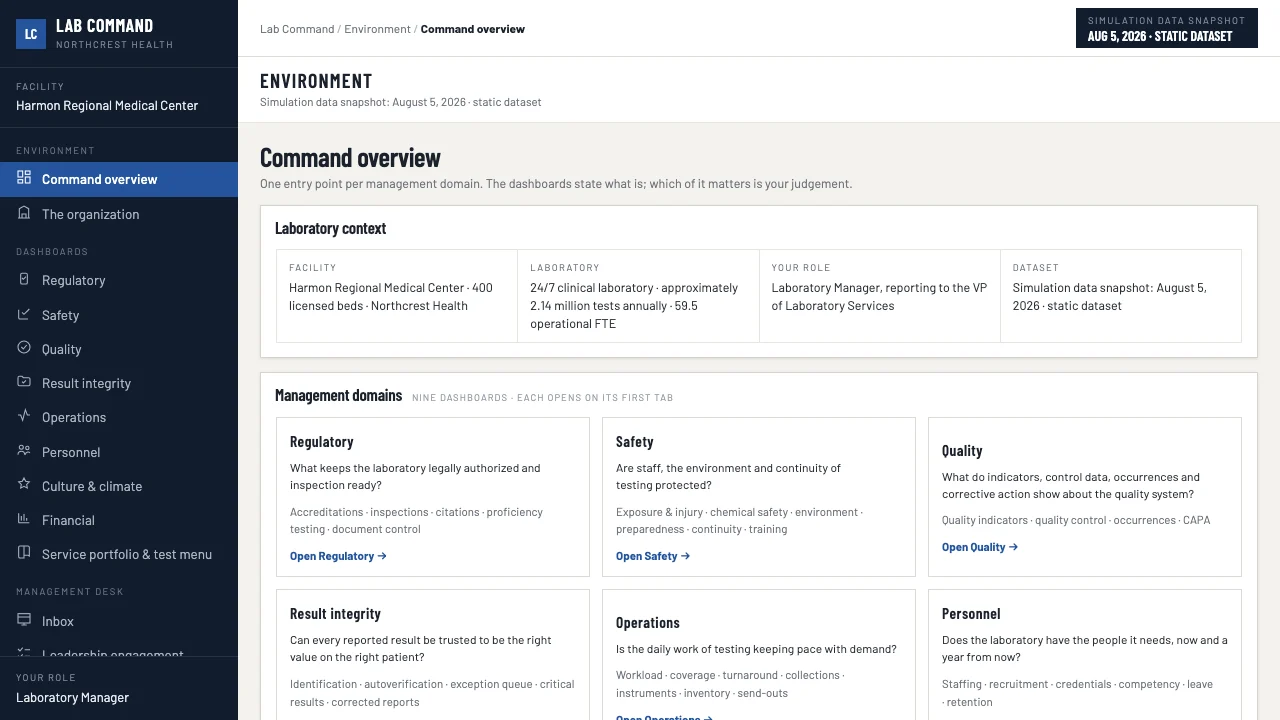
Lab Command is a semester-long clinical laboratory management simulation in which students inherit a persistent fictional laboratory and manage it across the major responsibilities of laboratory leadership.
Students work from management dashboards, operational reports, cases, transaction data, and other evidence about the laboratory. Across the semester, they evaluate safety, quality, regulatory performance, result integrity, operations, personnel, culture and climate, financial conditions, and the laboratory's service portfolio. The dashboards provide information rather than answers, so students have to determine what matters, identify priorities, make management decisions, and defend those decisions.
The simulation is designed to move laboratory management from a set of topics to a sustained management experience.
- 14-Week Management Simulation
- Evidence Warehouse
- Executive Defense
Team Climate in Healthcare
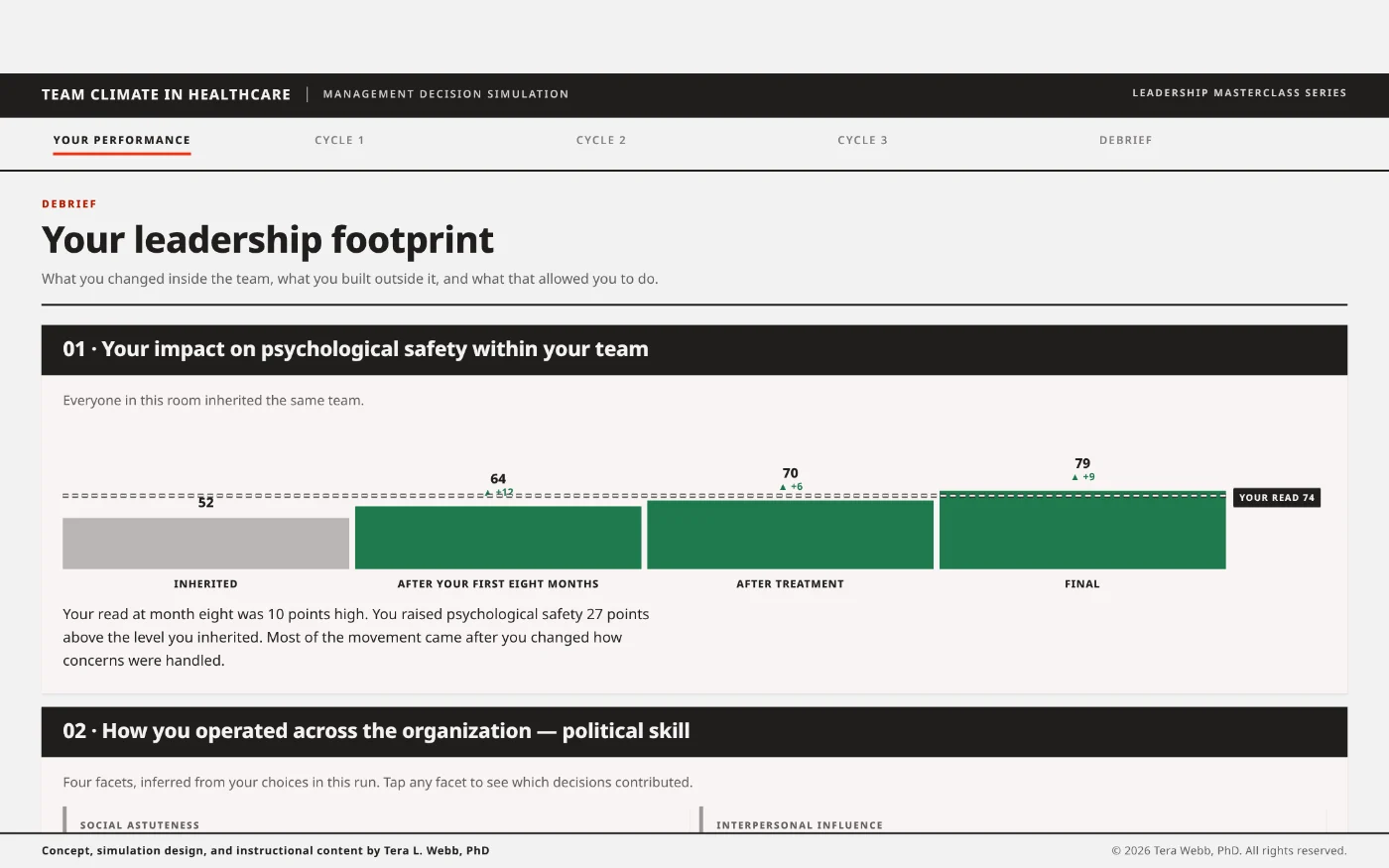
An immersive leadership simulation that places participants inside the management of a healthcare team rather than teaching psychological safety as an abstract concept.
Participants move through a baseline and then Diagnose, Treat, and Monitor the team over time. They review incomplete evidence, decide what deserves attention, choose how to intervene, and work within the relationships, resources, and influence available to them. The final debrief reconstructs the full run, including changes in team climate, where the leader's own reading of the team was incomplete, and how relationships outside the team affected the ability to act.
The experience teaches participants to distinguish their own perception of the team from evidence about the team, and to separate knowing what should change from having the organizational capacity to change it.
- Diagnose → Treat → Monitor
- Leadership Footprint
- Political Capital
Team Agreement Builder
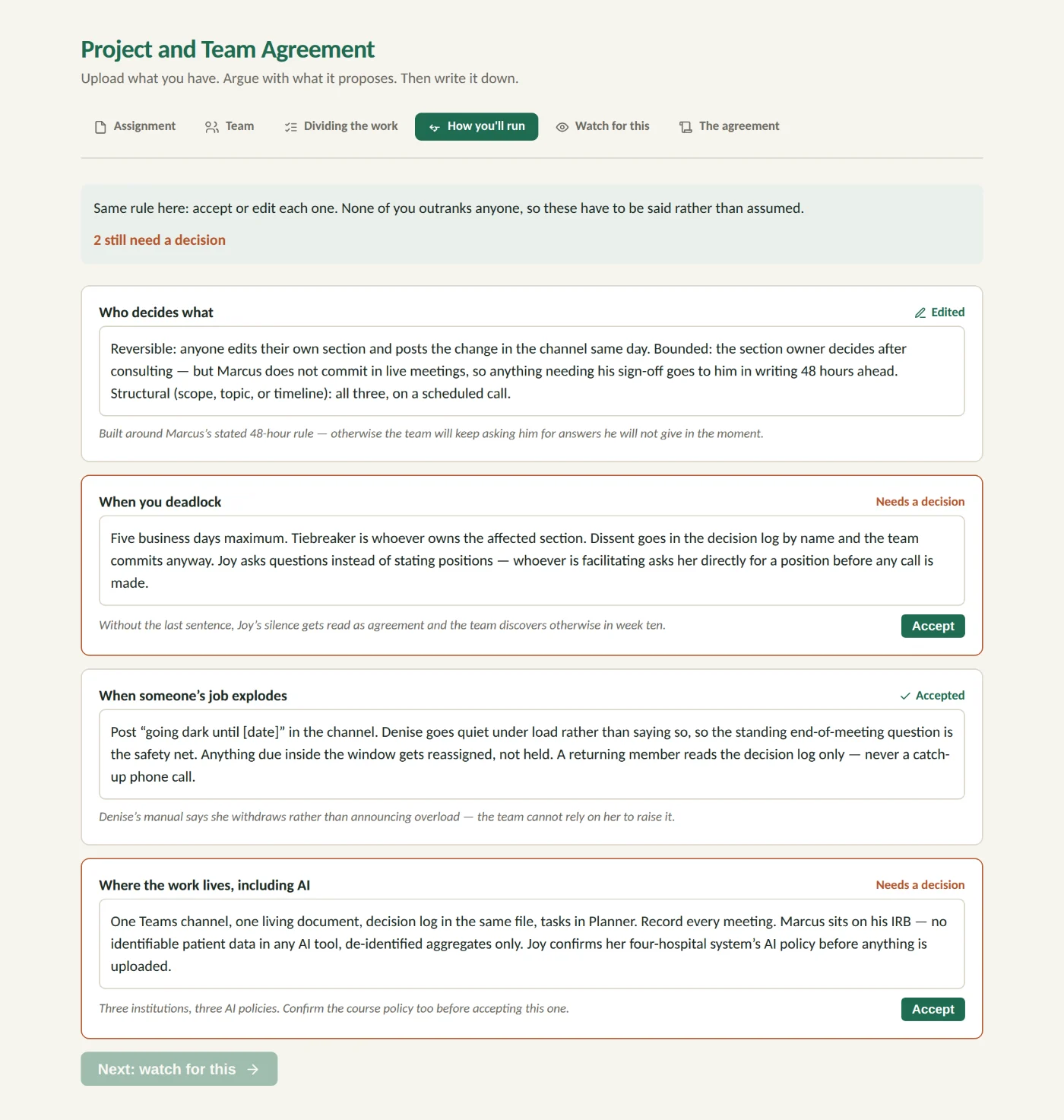
A guided conversation that helps student teams make their working expectations explicit before a problem occurs.
The tool takes a student team through decisions about purpose, roles, communication, participation, missed deadlines, disagreement, decision making, and what the group will do when a member stops responding. The students work through the prompts together and leave with a written agreement they can keep and revisit. No account is required, and nothing is stored.
Open the Team Agreement ToolIn development
These are under active development.
The Work Beneath the Dashboard
A management simulation about the gap between how work is designed, monitored, and reported and how employees actually get the work done.
Participants begin with the view available to management: formal workflows, performance targets, and dashboards that suggest the operation is functioning as expected. Additional evidence gradually reveals the adaptations employees are making to meet those expectations. Participants have to reconstruct the work as it is actually being performed and identify what management could not see from the formal reporting structure alone.
The simulation uses the distinction between work as imagined and work as done to show how formal processes, targets, and reporting can leave leaders with an incomplete view of the work.
The experience examines management blindness and the risks created when leaders mistake work as imagined for work as done.
- Work as Imagined vs. Work as Done
- Management Blindness
- Frontline Adaptation
Before You Blame
An error-management simulation that asks participants to classify what happened before deciding who, if anyone, should be held accountable.
Participants work through incidents involving different sources of failure, including human slips and lapses, dependency or system failures, unclear or unrealistic processes, at-risk behavior, and reckless behavior. For each scenario, they determine what kind of error or behavior occurred, what conditions contributed to it, and what response is appropriate. The exercise makes participants distinguish an adverse outcome from misconduct rather than treating every person connected to an event as someone who should be penalized.
The goal is to improve error classification and match the response to the type of failure: learning and system redesign when the problem is structural, support after human error, coaching when risk has become normalized, and discipline when behavior is reckless.
This project follows The Work Beneath the Dashboard in the Work as Done simulation sequence.
- Just Culture
- Error Classification
- System Dependency Failures
- Swiss Cheese Model
Research Publication Scaffolding Agent
A research-structuring agent that helps scholars organize an idea or manuscript before and during writing without generating the manuscript for them.
The agent helps separate the intellectual work from the structural work. It can take a researcher's existing ideas, notes, coded evidence, or draft material and organize them into a research blueprint showing what each section and paragraph needs to accomplish. It can also reverse-engineer articles from a target journal to identify recurring expectations for problem framing, theory placement, evidence, sequencing, and contribution.
The researcher writes the prose and retains control of the theory, claims, interpretation, and argument. The agent supports placement, sequencing, paragraph structure, citation roles, journal alignment, and flow diagnosis.
The tool reduces the structural and organizational burden of publication while keeping the researcher responsible for the scholarship itself.
- Research Blueprints
- Manuscript Architecture
- Journal Calibration
Want to make something together?
If you have a problem you want to work on together, tell me what you are trying to make possible. We can adapt one of these projects or build something new.